
Table of Contents
- Key Takeaways
- Why is a snake plant perfect for beginners?
- What type of light does it need?
- How often should you water it?
- What soil and pot are best?
- How to maintain and clean snake plants?
- Common problems and easy solutions
- Quick care table
- Conclusion
- Frequently asked Questions
Key Takeaways
- Snake plants require less water and indirect sunlight.
- The biggest error is overwatering.
- Well-draining soil helps in preventing root rot.
- It is perfect for beginners and busy people.
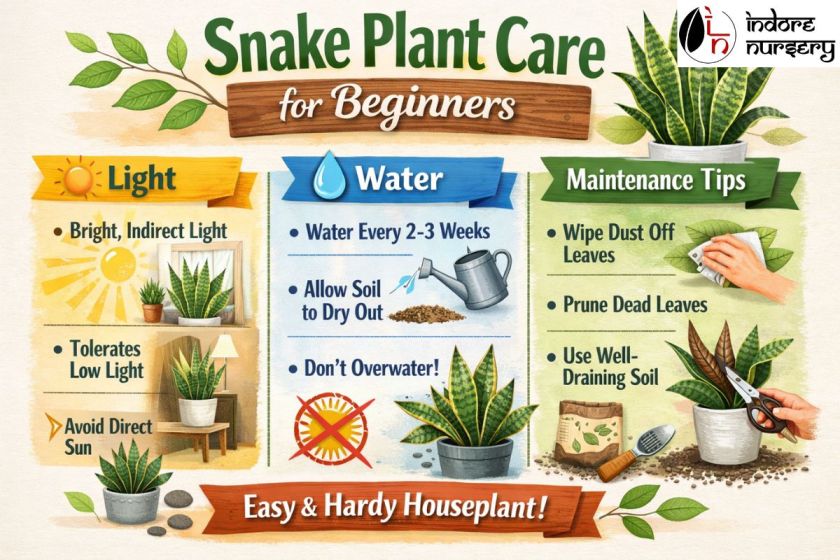
The snake plant is among the simplest indoor plants that can be cultivated. It requires minimal water and can withstand low light. When you are purchasing from an online plant nursery in Indore, it is ideal when you are a beginner. At Indorenursery, people prefer this due to its low maintenance and durability.
Why is a snake plant perfect for beginners?
The snake plant known as Sansevieria, or mother-in-law’s tongue, is considered a hard plant. It is resistant to various indoor conditions. Therefore, though you may forget to water it occasionally, it still grows well.
Here’s why beginners love it:
- It tolerates low light.
- It needs less water.
- It enhances the quality of indoor air.
- It develops at a slow pace and therefore requires minimal trimming.
- It rarely attracts pests.
Additionally, snake plants can be placed in small flats, offices, and balconies. It is one of the safest options when buying plants as a first-time parent, whether you purchase it in a local plant nursery in Indore or online.
At Indorenursery, customers often share that snake plants survive even in busy schedules. That makes it ideal for working professionals and students.
What type of light does it need?
Snake plants are highly adaptable in regard to light. Nevertheless, adequate light assists them to grow quicker and appear healthier.
Best Light Conditions
- Sunlight of bright indirectness is preferred.
- Indoor medium lighting is effective.
- Poor lighting will be tolerable, but the growth will be slow.
- Strong direct afternoon sunlight should be avoided.
When you put it close to a window whose light is filtered by the curtains, it grows well. Nevertheless, it is not advisable to put it in the dark.
When you are purchasing online indoor plants in Indore, you should ensure that you check where you will store the plant. Therefore, select an area that has some natural light to grow better.
Signs of Light Problems
- Leaves grow pale– Excess sunshine.
- Slow growth- Very low light
- Leaves bending- There is lack of brightness.
Snake plants adapt well; however, when the light is balanced, they are healthy and upright.
How often should you water it?
The largest error that beginners commit is overwatering.
Snake plants have thick leaves that store water. As such, they do not require watering frequently.
Basic watering rule
- Water when the soil is fully dry.
- In summer: Every 2–3 weeks.
- During winter: Once a month suffices.
Insert your finger in the soil before watering. When it is dry 12 inches deep, water it.
Important watering tips
- Do not leave water in the tray.
- Always use a draining pot.
- Do not water the leaves.
- Better to have less water than to have too much.
Furthermore, root rot occurs when the soil is kept wet over a long period. This is the reason why it is essential to have proper drainage.
At Indorenursery, the plant specialists would always recommend the beginners use the dry soil check method. It averts the majority of plant problems.
What soil and pot are best?
The snake plant does not require special soil. Nonetheless, healthy roots are maintained in well-draining soil.
Best Soil Type
- Cactus mix soil
- Sandy soil mixture
- Loose and airy potting mix
Moreover, heavy clay soil is not to be used since it retains excess water.
Choosing the Right Pot
- A pot must have drainage holes.
- Plastic is inferior to terracotta pots.
- The size of the pot must not be excessive.
When a pot is large, the soil remains wet. However, select a pot that is a bit tight. Snake plants can be cultivated in small containers.
Additionally, if you are planning to decorate balcony spaces using online outdoor plants in Indore, snake plants can also survive in that area provided that they are not exposed to heavy rain.
How to maintain and clean snake plants?
Maintenance is very simple.
1. Cleaning the Leaves
Light absorption can be blocked by dust. Therefore:
- Cleanse with a soft wet cloth after every 2-3 weeks.
- Do not use chemicals.
- Support tall leaves while cleaning.
Healthy clean leaves are shiny.
2. Fertilizing
- Use mild liquid fertilizer.
- Apply once in 2–3 months.
- Do not fertilize in winter.
Nevertheless, the snake plant is able to live without fertilizer. It is not mandatory but voluntary.
3. Pruning
- Remove yellow or damaged leaves.
- Using clean scissors, cut off the base.
- Do not trim healthy leaf tips.
Additionally, snake plants are slow-growing. It does not need heavy pruning.
Common problems and easy solutions
Even simple plants may experience minor problems. We should know them well.
1. Yellow Leaves
Reason:
- Overwatering
Solution:
- Reduce watering.
- Check drainage holes.
2. Soft Mushy Leaves
Reason:
- Root rot
Solution:
- Remove affected parts.
- Change soil immediately.
3. Brown Tips
Reason:
- Too much direct sunlight
- Very dry air
Solution:
- Move the plant to indirect light.
- Maintain balanced room ventilation.
4. Leaning Leaves
Reason:
- Not enough light
Solution:
- Move to a sunnier place.
At Indorenursery, the specialists in the plant advise that the leaves should be observed frequently. The stress is always early to be detected in leaves.
Quick care table
| Care Factor | Ideal Condition |
| Light | Bright indirect light |
| Water | Every 2–3 weeks |
| Soil | Well-draining mix |
| Pot | With drainage hole |
| Fertilizer | Once in 2–3 months |
| Cleaning | Wipe leaves regularly |
This is a basic table that includes all the beginners require.
Conclusion
The care of snake plants is not difficult provided that you can control light, water, and simple care. It is a strong, easy-to-grow plant that thrives with the least effort. In case you desire a good green choice with a good trustworthy source such as Indorenursery, then you can select a good online plant nursery in Indore and be assured of healthy plants being delivered to your doorstep.
Plant small, water according to schedule, and provide adequate light, and your snake plant will be healthy in years to come.
Frequently asked Questions
- Can snake plants survive in low light?
Yes, but growth will be slower.
- How do I know if I overwatered it?
Leaves become yellow and soft.
- Should I mist snake plant leaves?
No, misting is not required.









Recent Comments